Upgrading an existing domestic heating system from a traditional fossil-fuel boiler to an air source (ASHP) or ground source (GSHP) heat pump is one of the most effective ways to slash carbon emissions and future-proof home heating. However, the most critical engineering challenge during a heat pump retrofit is emitter sizing and hydronic flow management.
Traditional gas and oil boilers typically circulate heating water at 75°C flow and 65°C return. Heat pumps, by contrast, achieve peak seasonal efficiency (SCOP) when operating at low flow temperatures between 35°C and 45°C. Sizing radiators correctly for low-temperature operation requires a solid understanding of Delta T (ΔT), non-linear convective physics under BS EN 442, and hydronic mass flow rates.
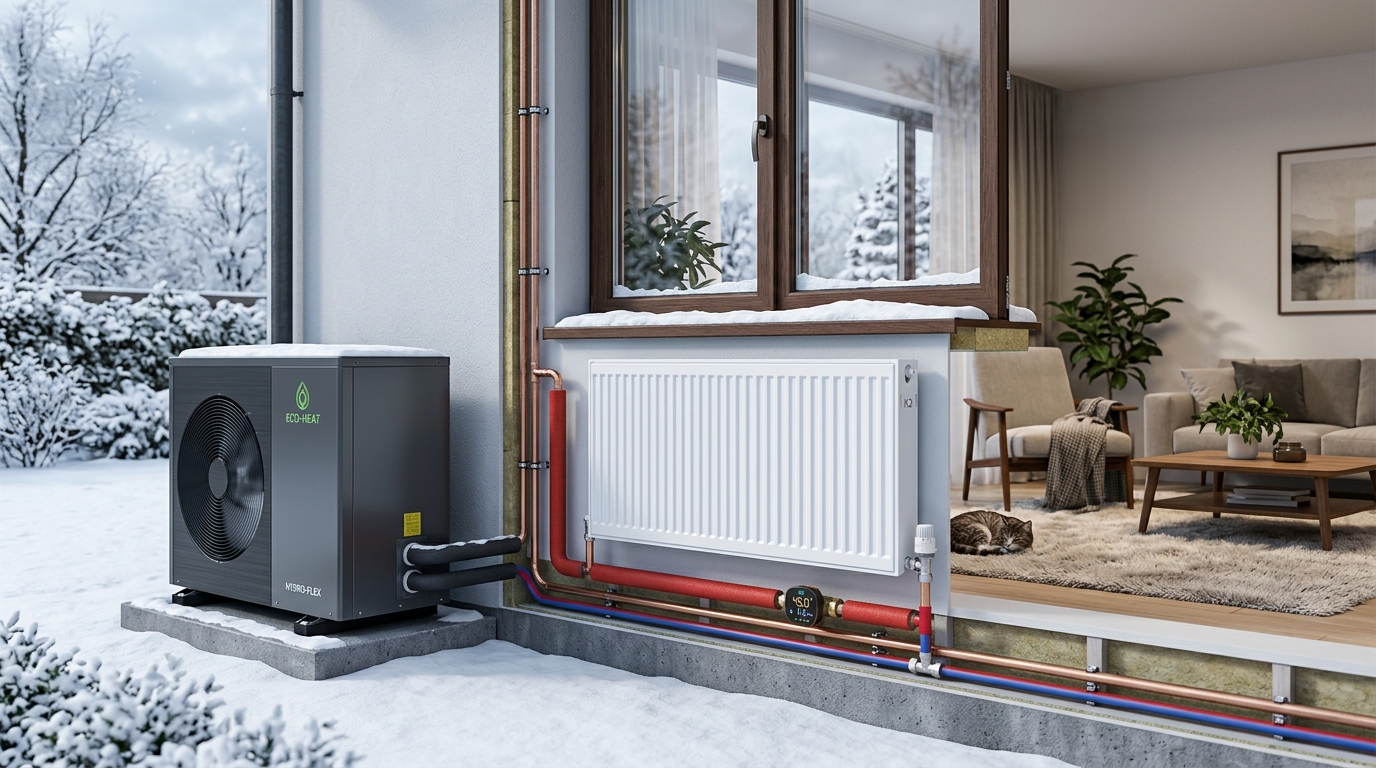
1. What is Delta T (ΔT) in Hydronic Heating?
Delta T (ΔT, or temperature difference) represents the thermal driving force between the average water temperature inside the radiator and the surrounding ambient room air:
ΔT = T_mwt - T_room = ((T_flow + T_return) / 2) - T_room
Where:
- T_flow: The temperature of water leaving the heat generator and entering the radiator.
- T_return: The temperature of water leaving the radiator and returning to the heat generator.
- T_mwt (Mean Water Temperature): The arithmetic average of flow and return temperatures.
- T_room: The target design room temperature (typically 20°C to 21°C).
Comparing Operating Delta T Across Systems:
- ΔT50 (Standard High-Temperature Gas Boiler):
- Flow: 75°C, Return: 65°C, Room: 20°C
- Mean Water Temp: (75 + 65) / 2 = 70°C
- ΔT = 70°C - 20°C = 50 K (This is the standard manufacturer catalog test rating condition).
- ΔT30 (Standard Low-Temperature Heat Pump):
- Flow: 50°C, Return: 40°C, Room: 20°C
- Mean Water Temp: (50 + 40) / 2 = 45°C
- ΔT = 45°C - 20°C = 25–30 K.
- ΔT20–ΔT25 (Ultra-Efficient Low-Temperature Heat Pump):
- Flow: 45°C, Return: 40°C, Room: 20°C
- Mean Water Temp: (45 + 40) / 2 = 42.5°C
- ΔT = 42.5°C - 20°C = 22.5 K.
2. The Physics of Radiator Heat Output: The BS EN 442 Formula
Many homeowners and untrained installers mistakenly assume that radiator heat emission scales linearly with water temperature (e.g., that running a radiator at ΔT25 yields 50% of its ΔT50 capacity).
In reality, radiators emit heat through a combination of radiation (infrared emission) and natural convection (air warming and rising through the internal fins). As water temperature drops, convective airflow velocity slows down significantly. Under the European Standard BS EN 442, the relationship is non-linear and governed by a characteristic exponent (n):
Output = Base_Output × (ΔT / 50)^n
Where:
- Base_Output: Manufacturer catalog rated output at baseline ΔT = 50 K (Watts).
- n: The radiator characteristic exponent (standardized at n = 1.30 for steel panel convector radiators).
Calculating the Delta T Correction Factor (F)
To find how much heat a radiator will emit at any operating temperature, compute the correction factor F:
F = (ΔT / 50)^1.30
| Operating Condition | Flow / Return Temp | Mean Water Temp | Room Temp | Effective ΔT | Correction Factor (F) | Sizing Multiplier (1/F) |
|---|---|---|---|---|---|---|
| Standard Boiler (ΔT50) | 75°C / 65°C | 70°C | 20°C | 50 K | 1.000 (100%) | 1.00 × |
| High-Temp HP / Low Boiler (ΔT40) | 65°C / 55°C | 60°C | 20°C | 40 K | 0.748 (74.8%) | 1.34 × |
| Medium-Temp HP (ΔT35) | 60°C / 50°C | 55°C | 20°C | 35 K | 0.629 (62.9%) | 1.59 × |
| Standard Heat Pump (ΔT30) | 55°C / 45°C | 50°C | 20°C | 30 K | 0.514 (51.4%) | 1.95 × |
| Low-Temp Heat Pump (ΔT25) | 50°C / 40°C | 45°C | 20°C | 25 K | 0.406 (40.6%) | 2.46 × |
| Ultra Low-Temp HP (ΔT20) | 45°C / 35°C | 40°C | 20°C | 20 K | 0.304 (30.4%) | 3.29 × |
Key Rule of Thumb: At standard heat pump flow temperatures (ΔT30), a radiator delivers approximately half (51.4%) of its catalog rated ΔT50 output. Therefore, you must select a radiator with approximately double (1.95×) the catalog capacity.
3. The 2.5% Rule: Why Lower Flow Temperatures Save Money
Why not simply run the heat pump at 60°C or 65°C to avoid replacing radiators?
The thermodynamic efficiency of a heat pump is governed by the Carnot refrigeration cycle. The closer the output flow temperature is to the outdoor source temperature, the less work the compressor must do to lift heat.
In residential practice, heating engineers apply the 2.5% Rule:
For every 1°C you reduce the heat pump flow temperature, the seasonal coefficient of performance (SCOP) increases by approximately 2.5%.
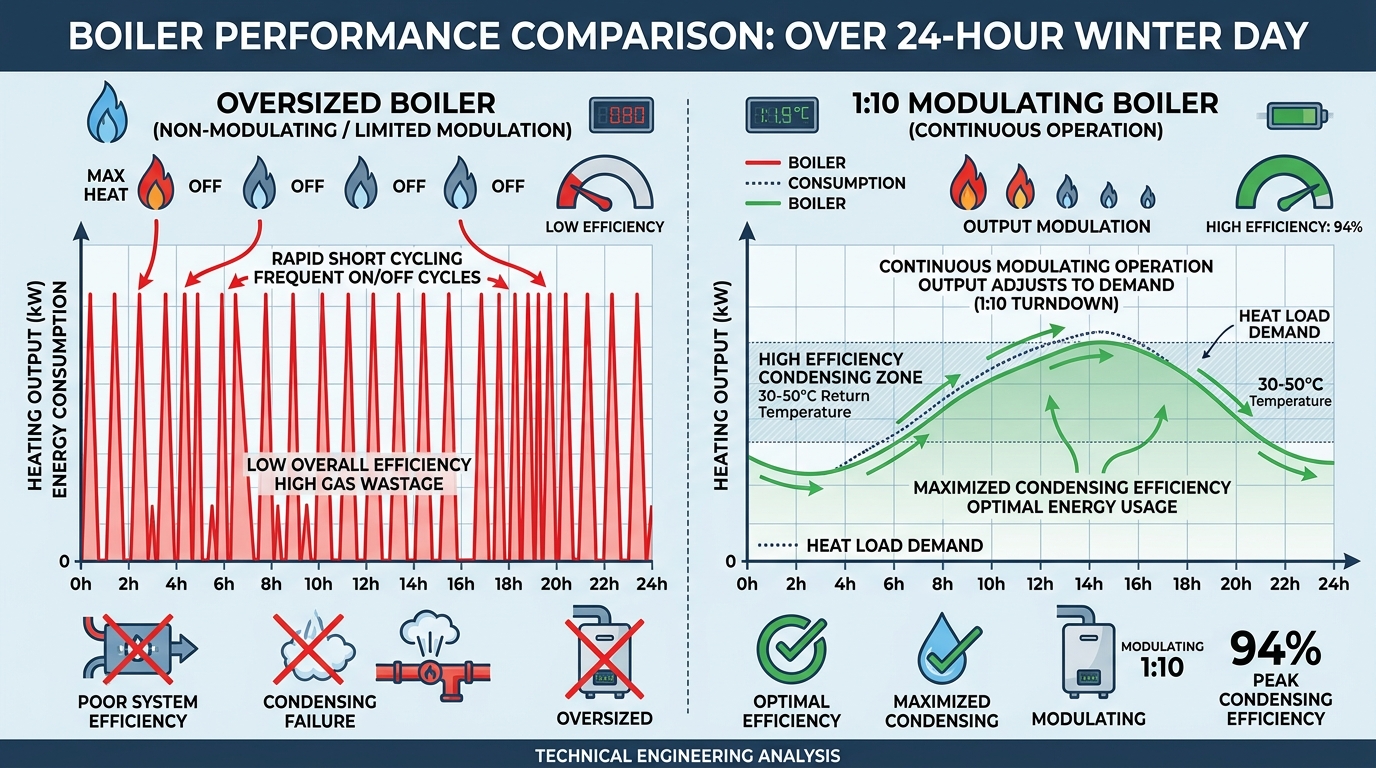
Financial Impact on a Typical 12,000 kWh/year Home:
- Operating at 55°C Flow (SCOP 3.00): Consumes 4,000 kWh electricity × 28p/kWh = £1,120 / year.
- Operating at 45°C Flow (SCOP 3.80): Consumes 3,158 kWh electricity × 28p/kWh = £884 / year (£236/year saved).
- Operating at 35°C Flow (SCOP 4.60): Consumes 2,608 kWh electricity × 28p/kWh = £730 / year (£390/year saved).
Over a 15-year heat pump lifespan, sizing radiators for 45°C instead of 55°C saves over £3,500 in electricity running costs—far exceeding the one-off cost of upgrading a few radiator panels.
4. Radiator Panel Types Compared (Type 11 to Type 33)
When upgrading radiators for low-temperature heat pump operation, homeowners often worry they will not have enough wall space to double the size of their radiators. Fortunately, you can increase thermal surface area by increasing panel depth rather than wall width:
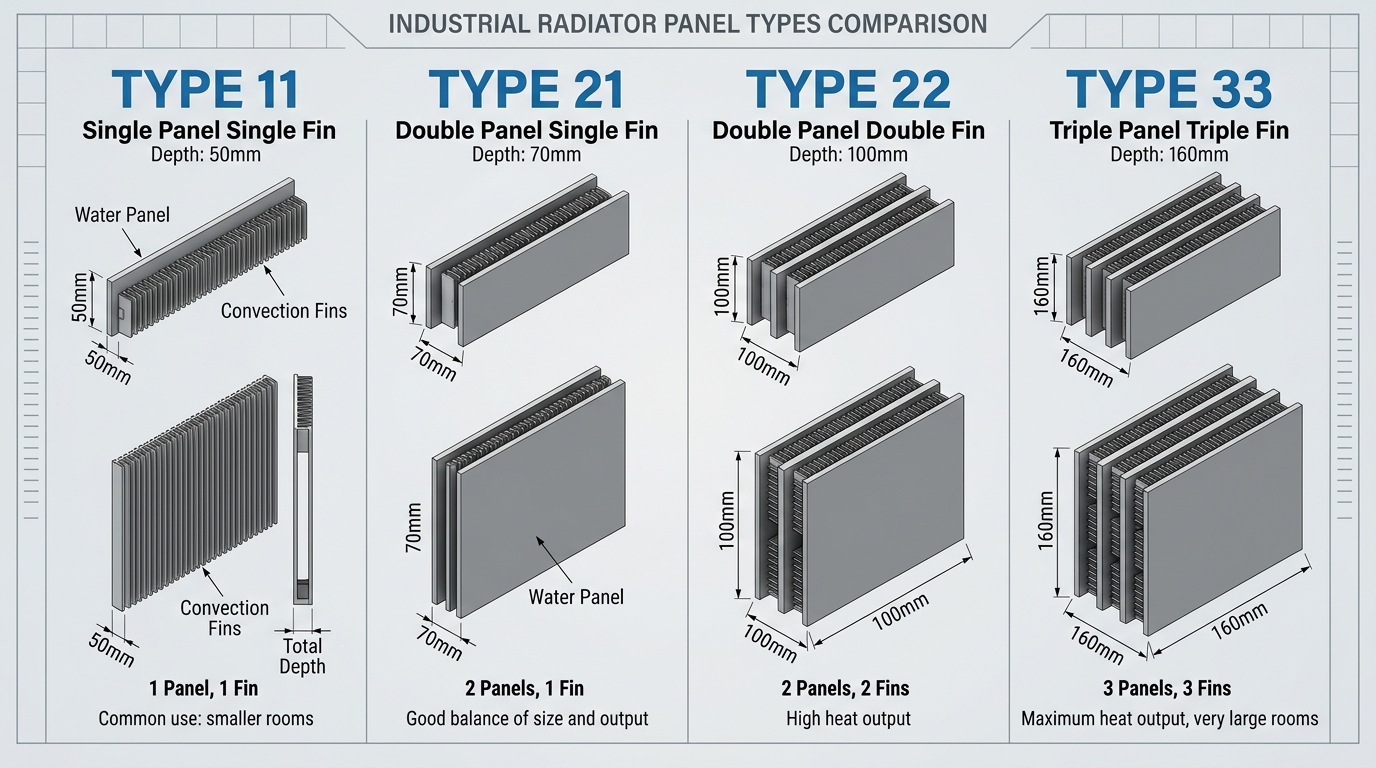
| Radiator Type | Common Name | Plates / Fins | Depth Profile | Output @ ΔT50 (600mm H) | Output @ ΔT30 (600mm H) | Best Application |
|---|---|---|---|---|---|---|
| Type 11 | K1 (Single Convector) | 1 Plate, 1 Fin | 50 mm (2.0 in) | 950 W / metre | 488 W / metre | Narrow hallways, cloakrooms, behind doors where wall depth is restricted. |
| Type 21 | P+ (Double Panel Plus) | 2 Plates, 1 Fin | 70 mm (2.8 in) | 1,350 W / metre | 694 W / metre | Compact bedrooms and low-loss spaces. |
| Type 22 | K2 (Double Convector) | 2 Plates, 2 Fins | 100 mm (4.0 in) | 1,800 W / metre | 925 W / metre | The UK heat pump workhorse. Delivers 90% more heat than Type 11 in the same wall width. |
| Type 33 | K3 (Triple Convector) | 3 Plates, 3 Fins | 160 mm (6.3 in) | 2,550 W / metre | 1,310 W / metre | High-demand living rooms, dining rooms, and solid-wall homes with limited window wall length. |
Retrofit Strategy: In most existing homes, simply swapping older single-panel (Type 11) radiators for double-convector (Type 22) or triple-convector (Type 33) radiators of identical length provides 100% of the required heat pump surface area without needing new pipe tails or altering furniture layouts.
5. Hydronic Flow Rates and Pipe Sizing
A critical and frequently overlooked aspect of low-temperature radiator design is water mass flow rate.
Because low-temperature systems operate with a smaller temperature drop (ΔT_circuit = 5–7 K for heat pumps versus 20 K for modern boilers), the water flow rate required to deliver the same amount of heating energy is significantly higher:
Flow Rate (kg/s) = Power (kW) / (4.187 × ΔT_circuit)
Comparison for an 8 kW Heat Demand:
- Gas Boiler (ΔT = 20 K): Flow Rate = 8.0 / (4.187 × 20) = 0.095 kg/s = 5.7 Litres/minute.
- Heat Pump (ΔT = 5 K): Flow Rate = 8.0 / (4.187 × 5) = 0.382 kg/s = 22.9 Litres/minute (4× higher flow rate!).
Pipe Diameter Recommendations:
- Main Flow & Return from Heat Pump: 28mm copper or 32mm MLCP.
- Distribution Headers & Manifold Branches: 22mm copper or 26mm MLCP.
- Individual Radiator Tails (up to 1,500W): 15mm copper or 16mm MLCP.
- Microbore Warning: Small 8mm or 10mm microbore pipework cannot carry high heat pump flow rates without excessive hydraulic resistance and flow velocity noise.
6. Top 5 Low-Temperature Radiator Sizing Errors
- Relying on Boiler ΔT50 Catalog Ratings: Purchasing a 1,500W catalog radiator for a 1,500W room on a heat pump results in a room that only receives 770W and stays freezing cold.
- Ignoring Hydronic Flow Balancing: Leaving lockshield valves wide open starves radiators on the end of pipe runs and causes system water to bypass back to the heat pump too hot.
- Covering Radiators with Decorative Grilles: Wood radiator grilles restrict natural convective air chimney effect by 25%–35%, severely degrading low-temperature performance.
- Neglecting TRV Valve Authority: Fitting non-pre-setting TRVs makes hydronic balancing impossible, leading to noisy high-velocity flow whistling.
- Over-Sizing Radiators Unevenly: Sizing some rooms for 45°C flow and leaving other rooms undersized at 55°C forces the whole system to run at the higher temperature, destroying overall seasonal efficiency.
7. Interactive Calculation Engines
Use our dedicated engineering tools to calculate your room loads and verify radiator dimensions:
- Radiator Size Calculator: Interactive BS EN 442 Delta T correction calculator with Type 11–33 panel matcher.
- Heat Pump Size Calculator: Size MCS-compliant ASHP/GSHP systems and optimize flow temperature SCOP.
- Room-by-Room Schedule Generator: Complete multi-room schedule with instant CSV export.
- Whole House Calculator: Estimate total building heat loss in kW and annual seasonal fuel costs.